By Aisha Bailey
So, let me get this straight: A man whose ancestors came to this country in the late 1800s—migrating from border to border, slipping in and out of Canada, traveling to Germany and returning with a wife to settle and start a family in the Northeast—is now the one dictating who gets to belong in America? He is now setting policies that exclude millions of others based on so-called chronological superiority, geopolitical status, and—let’s be honest—racial identity?
Let us pause and think about this.
The people most often labeled “illegal immigrants”—we know who they are, we know what they look like—are in fact of the same land mass that they are being expelled from. For immigration policy to have any credibility, it must account for the artificial geopolitical boundaries that divide this continent. North America. Central America. South America. Mexico. These divisions are human made. Strip them away, and it’s all one land. One people.
And if we want to talk about chronological agency, let us talk about the Indigenous peoples—those who lived on this land for thousands of years before any modern borders existed. The same Indigenous peoples who were driven off, exterminated, or forcibly assimilated by white settlers like Andrew Jackson and others—long before many of today’s lawmakers’ ancestors even set foot in this country.
So how can someone be “illegal” on a land their people have occupied longer than any European nation has existed? It makes no sense—historically, morally, or spiritually. But we have been trained to look at this land through the lens of borders, laws, and flags. And through that lens, we convince ourselves that these newcomers are “outsiders”—when in fact, they are the original Americans.
And here is the bitter irony: The very people screaming about “illegal immigration” often come from families who themselves were not accepted when they first arrived. Many came in waves between the 1880s and 1950s, fleeing famine, war, or persecution. They were called slurs. They were denied housing, work, and dignity. In some cases, they were considered less than African Americans.
And yet, through war, legislation, and social maneuvering, these groups eventually became white. The G.I. Bill, post-WWII suburban expansion, and the cultural flattening of ethnicity helped forge a new, vague identity: the white American. It was during this era—the mid-1940s to 1960s—that whiteness became normalized, glorified, and weaponized. This is the era so many long to return to: a time when racial hierarchies were unquestioned, women were silenced, and anyone who did not fit the mold was “othered.”
But we cannot go back. And we should not want to.
This nostalgic longing for the 1950s is not about safety, or family, or values. It’s about control. It’s about reviving a time when white men ruled unquestioned, women stayed pregnant and silent, and anyone who was not white was either invisible or oppressed. The push to turn back the clock on immigration, on reproductive rights, on civil liberties—is not about patriotism. It’s about fear and power. And it’s about forgetting whose land this was in the first place.
Let us be brutally honest: If we applied the same “chronological superiority” logic to immigration that some use today—if we rewound the clock to 1887 or even 1776—most white Americans would not qualify to be here. They were not here yet. And they would have no claim to this land under the same rules they now enforce on others.
So, if this country is going to play by the rules of ancestral legitimacy—be careful. Because the very policies some uphold today could be turned around tomorrow. Pick a different point in history, and the whole power structure flips.
And that is the point.
Chronology and geography do not make someone more American. Honor does. Integrity does. Truth does. And right now, truth is being buried under slogans, fear, and the rewriting of history.
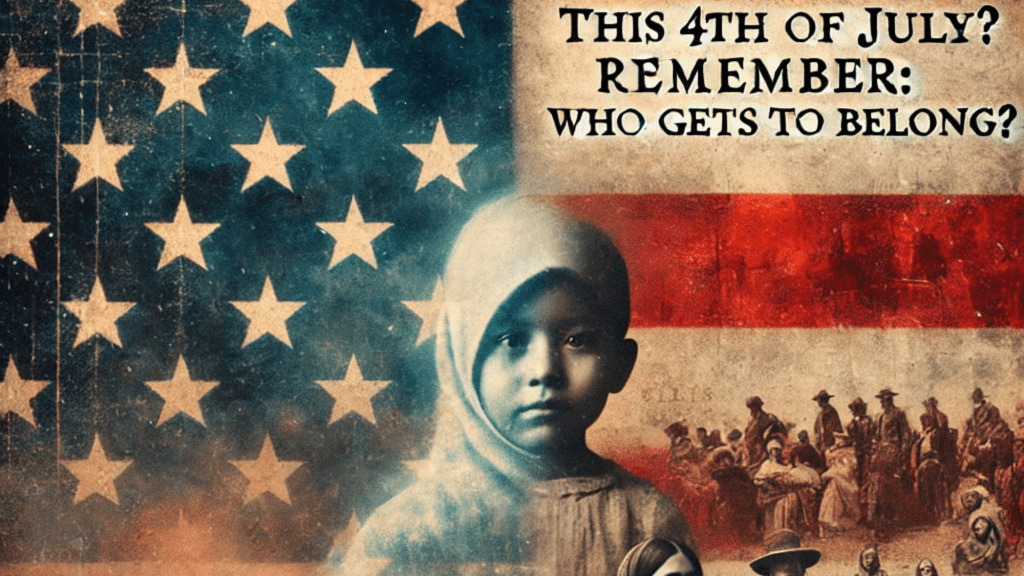
This 4th of July, as you hold your flag and sing the anthem, do your research. Find out when your family came here. Learn what they endured, and what they were given. And remember this: If we go back to 1776, I would still be here. So would many other Black, Brown, and Indigenous Americans. But many of those white Americans who are trying to write today’s exclusionary laws? Their families would not make the cut.
So maybe—just maybe—it’s time to stop gatekeeping a country you arrived in late. Be grateful. Be humble. And do not use the privileges you inherited to deny others their humanity.
Freedom, for now. Let us make it freedom for all.
 Health Equity from the inside out
Leave a comment